

What happens to payroll when the one person who knows the salary formula is out sick? This guide shows what HRM protects in a Bangladeshi business, and which of hiring, pay, and retention to fix first.
What happens to your payroll if the one person who knows the salary formula is out sick on the 5th? If you hesitated before answering, this article is for you.
The importance of HRM comes down to three jobs: choosing who joins your team, paying them correctly and on time, and giving them reasons to stay. Any business with even a handful of employees already does these jobs, on purpose or by default.
Doing them on purpose means writing the process down, so nothing important lives in one person’s head. This guide shows what that protects in a Bangladeshi business, and which of the three jobs to fix first.
What HRM Does Inside a Bangladeshi Business
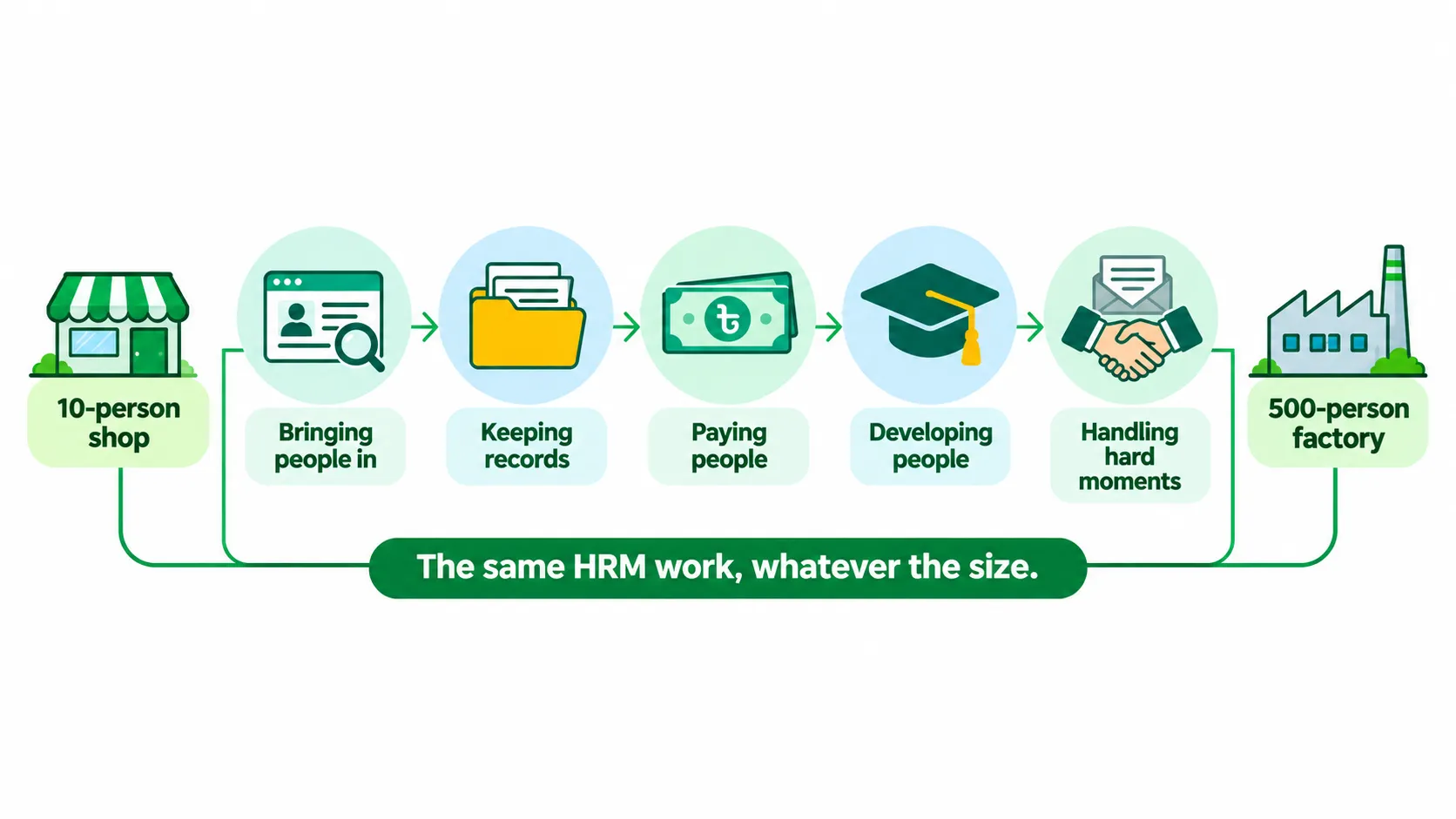
The easiest way to see HRM is to watch what it touches in an ordinary month. It begins before a person joins and carries on after they leave.
Bringing people in: job posts, screening, interviews, offers, and appointment letters.
Keeping records: contracts, ID cards, attendance, leave balances, and personnel files.
Paying people: salary runs, overtime, festival bonuses, deductions, and tax.
Developing people: onboarding, training, appraisals, and promotions.
Handling hard moments: complaints, warnings, resignations, and final settlements.
In a ten-person firm, an owner or accountant does all five between other jobs. In a 500-person factory, a team does. The work is the same, but the cost of doing it badly grows with every added employee.
Mehboobur Rehman, a Bangladeshi HRM consultant, told The Business Standard in 2020 that every line manager is also a people manager, whatever their job title says. That means HRM is never only the HR person’s job.
It also starts upstream, with workforce planning, which decides how many people you need and when.
Why the Importance of HRM Runs Higher in Bangladesh Than Textbooks Suggest
Most HR content online was written for other markets. Three local conditions change the picture here.
The label changed, but the work did not. In that same Business Standard interview, Rehman said many private-sector owners renamed “Personnel” to “HR” and kept a clerical mindset behind the new sign.
Labour law reaches workers more than office staff, and enforcement is uneven. A Lex Mundi employment-law guide notes that the Bangladesh Labour Act mainly applies to workers.
A July 2026 Prothom Alo report says the Act and the 2015 Rules outline protections for private-sector staff, but implementation at the field level is missing. It adds that a government effort to draft service rules for private employees, with review due in May, showed no visible progress.
Trained HR managers are scarce. Rehman pointed to a shortage of competent HR managers in 2020, and a Daily Star column observed that HR in Bangladesh has been slower than its global counterparts to take on a strategic role. You cannot count on hiring your way out of weak HR.
The same Prothom Alo report says many private owners keep benefits such as provident funds, gratuity, and group insurance on paper only.
Put that together with the points above and an employer’s own habits decide how much employees trust the workplace, more than any outside rule does.
That is the real importance of HRM here: it replaces guesswork with a written, repeatable way of treating people.
The research points the same way. A 2012 study of publicly listed Bangladeshi manufacturers by Absar, Nimalathasan, and Mahmood, published in the South Asian Journal of Global Business Research, concluded that firms need systematic HRM practices to stay competitive.
Hiring the Right People Before Problems Start
A wrong hire costs you the interviews, the onboarding time, your manager’s patience, and sometimes a customer. HRM lowers that risk by making hiring consistent instead of improvised.
When applications arrive from job portals, Facebook groups, and referrals all at once, a fixed process matters more than gut feel. A basic version looks like this:
Write down what the role does and the two or three skills it cannot do without.
Screen every applicant against that same list.
Ask each shortlisted candidate the same core questions, so you can compare answers.
Check at least one reference before making an offer.
Issue a written appointment letter on the joining day.
Owners who cannot spare time for the first rounds sometimes hand screening to a recruitment process outsourcing partner and keep the final interview for themselves. Either way, the goal is the same: fewer surprises in month three.
Paying Accurately and on Time Builds Trust

Salary is the one HR output every employee checks every month. A late or wrong payment tells people more about your company than any values poster will.
Manual payroll breaks in predictable places: attendance sheets that disagree with approvals, overtime counted twice or missed, and bonus or tax deductions applied from memory.
Garment payroll is harder still. A payroll software vendor’s guide to RMG payroll lists overtime, attendance bonuses, production incentives, night allowances, and piece-rate pay on top of base wages.
It also notes that turnover and seasonal hiring change the employee list materially every month.
Overtime is where disputes start. Prothom Alo’s July 2026 report notes that the Labour Act sets a 48-hour working week, yet private-sector employees it interviewed say they work 10 to 12 hours a day with no overtime pay or transport allowance.
Those are employees’ accounts, not audit findings, but they show what unrecorded overtime does to trust.
Read employee reviews of Bangladeshi employers on Glassdoor and a pattern repeats: pay promised, pay delayed, resignations with dues still outstanding, and new hires brought in to replace the people who left.
These are individual accounts, not audited facts, but they show how a payroll lapse looks from the employee’s side.
Three habits prevent most of it:
Keep one attendance record that payroll reads from, instead of two.
Fix a monthly cut-off date and publish it.
Write down the salary formula, so one person’s absence cannot stop payday.
Firms that prefer not to run salary cycles themselves sometimes move the work to a payroll outsourcing provider, which trades some control for consistency.
Keeping Employees Long Enough to Repay Their Hiring Cost
Every resignation sends you back to the start of the hiring process. Retention is where HRM pays for itself, because a person who stays keeps the knowledge you spent months building.
Rehman called employee retention a significant problem for Bangladeshi employers, large and small. Garment-sector research shows how wide the gap between companies can be.
A University of Newcastle thesis on eight Bangladeshi RMG companies found overall turnover rates ranging from 11 percent to 33 percent.
A 2025 United International University project report cites annual turnover of 10 to 30 percent in a sector it says accounts for over 81 percent of exports and more than 4 million workers.
Both are garment-sector findings, so do not read them as a national average.
The UIU report’s small survey covered 45 employees across three medium-sized firms. It pointed to poor working conditions, limited professional growth, and inadequate pay as the main causes, and it linked recognition and transparency with lower turnover.
Pay stagnation makes it worse. Prothom Alo reports that stalled promotions and nominal yearly increments are the primary complaint of private-sector staff. It sets that against the new public pay scale, which lifts the minimum basic salary to Tk 20,000, a 142% jump. One employee quoted there cites inflation above 9 percent.
A Daily Star column goes further and says replacing one employee can cost more than their annual salary. That is a commentary claim, not a measured figure, but it shows how expensive leaving is.
HRM gives you three levers here:
Exit data: record why every person leaves, in one place, and review it each quarter.
A visible increment and promotion calendar: people stay when they can see the path.
Routine recognition: thanks given on a schedule beat thanks given in a crisis.
Meeting Labour Act Basics Without Chasing Paper

Compliance is where HRM prevents some of the most expensive disputes. Most of it is plain record-keeping done at the right moment.
Under Section 5 of the Bangladesh Labour Act, an employer must give each worker an appointment letter and a photo ID card at the employer’s expense.
The Act also requires a service book for every worker, provided at the employer’s cost and kept in the employer’s custody.
An employment-law resource from OGR Legal lists the registers an employer should keep:
Register of workers
Service book
Leave register
Register of wages
Register of deductions and fines
Register of overtime
A Teamed hiring guide adds that probation is capped at 3 months for manual roles and 6 months for clerical roles.
The law has been amended repeatedly in 2013, 2015, and 2018 according to a BIPO summary. Check the current text, or ask a labour-law adviser, before relying on any detail.
Because the Act mainly covers workers, office-based staff depend more on their contract and your written policy.
A starting checklist:
Appointment letter issued on the first day
Photo ID card issued
Service book opened and kept up to date
Clean leave, wage, and overtime records
A short written policy covering office-based staff
Building Skills Inside Your Own Team
Hiring a ready-made expert is slow and costly. HRM lets you grow the skills you already employ, which is usually faster.
A Daily Star column notes that training and development, once overlooked in Bangladesh, are now essential as businesses demand new skills.
HRM turns training from “send someone to a course” into a plan. List what each role needs, find the gap for each person, and train against that gap.
Frontline and field teams usually need short, role-specific modules rather than a long classroom programme, which is where structured workforce training fits. Tie the training to your appraisals so people see why it matters.
What HRM Looks Like at Different Business Sizes and Types
HRM is not one size. Different businesses feel the gaps in different places, so the first fix changes with the business.
Business type | Where HR gaps hurt first | Practical starting point |
Owner-run small business | Owner or accountant handles pay, leave, and hiring between other jobs; records live in notebooks and chat threads | Appointment letters, one attendance record, a written salary sheet |
Garment and light manufacturing | Variable pay, seasonal hiring, high turnover | Attendance-to-payroll link, exit-reason tracking, supervisor training |
Retail and multi-outlet services | Shift scheduling, turnover, overtime and festival bonuses | Shift calendar, standard pay rules per outlet, fast onboarding |
Field teams (delivery, sales, courier) | Knowing who worked where and when | Location-aware attendance, clear rules for salary advances |
Startups and office-based firms | No legal template for office staff, appraisal disputes, fast growth | Written policy, offer letters, a fixed appraisal cycle |
As headcount grows, the question shifts to who runs HR. That can be a dedicated team, a provider, or a mix, and the trade-offs are laid out in this comparison of in-house HR and HR outsourcing.
How Shomvob HRM Supports These Jobs

Shomvob sells the HR software, recruitment, staffing, and training services mentioned in this article, so read this section as the vendor’s own view.
Shomvob’s HRIS platform puts employee records, attendance with biometric device support, leave, payroll with statutory tax and deductions, and appraisals in one system. It also produces a bank disbursement file for salary runs.
Its employee-tracking feature covers field teams across all 64 districts, and new employers get a 30-day free trial with no credit card.
For companies that want payroll or workforce handling done externally, Shomvob also runs staffing and payroll solutions, and lists 2,832+ companies on its platform.
Start With Pay, People, and Paperwork, Then Build Outward
Do not try to build a full HR function in one quarter. Rank the three jobs by what hurts most this month: pay errors and delays, hiring and exits, or the records the law expects. Fix the one leaking the most trust or money first, then work outward.
For Bangladeshi owners and HR managers, the decision comes down to pay, retention, and records. Keep these points in mind:
Every business already does HRM. The choice is whether it is written down and repeatable.
Pay errors and delays damage trust fastest, so fix payroll first.
Track why people leave before you spend on retention programmes.
Issue appointment letters and keep records now. They cost little and prevent disputes.
Match your tools to your headcount, from notebook to spreadsheet to software.
If you want to see how this works with your own headcount, book a Shomvob HRM demo.
Frequently Asked Questions About HRM in Bangladesh
Why is human resource management important for a business?
It controls who gets hired, whether people are paid correctly and on time, and whether they stay. It also keeps the records that protect you in a dispute. Without it, those jobs still happen, but inconsistently.
Does a small business in Bangladesh need HRM?
Yes, in a lightweight form. You do not need a department. You need written terms for every employee, one reliable attendance and pay record, and a simple way to track why people leave.
What are the main functions of HRM?
Recruitment, onboarding, attendance and leave, payroll, training, performance appraisal, employee relations, and compliance records.
What happens when a company has no HR function?
Owners and accountants handle it by default. The usual results are inconsistent pay, missing appointment letters, and no exit data. For workers covered by the Labour Act, missing records can also create legal exposure.
Is HRM different from personnel management?
Yes. Personnel administration was mostly clerical record-keeping. HRM adds planning, development, and retention, and treats people as a long-term business asset.
When should a company hire its first dedicated HR person?
Look for signals, not a headcount number. The owner spends hours each month on payroll and hiring, pay errors repeat, resignations are rising, or records are missing.
Can HR software replace an HR manager?
No. Software handles attendance, payroll calculation, and records. Judgement calls, hard conversations, and policy decisions still need a person.