
Payroll errors start long before salary day. See the 7 features a payroll service in Bangladesh needs, from tax deduction at source to bank payouts and audit-ready records.
What happens to salary day when one branch sends its attendance sheet two days late, and a bonus lands after the tax figures are set? Many employers learn the answer the hard way, through late pay, wrong deductions, and unhappy staff.
A good payroll service in Bangladesh calculates pay from your attendance and leave data, deducts tax at source, complies with current labour rules, pays through your bank, and leaves records you can show an auditor.
The seven features below tell you whether a provider can do that. Use them as a checklist to determine whether you are choosing software, a managed service, or comparing both.
What a Payroll Service in Bangladesh Should Cover
Payroll is more than a salary calculation. It is a monthly chain, and a weak link anywhere shows up in your employees' bank accounts.
Collect the inputs: attendance, leave, overtime, new joiners, and exits.
Calculate gross pay, deductions, and tax.
Approve the run.
Pay through the bank.
Issue payslips and keep the records.
The seven features map onto this chain. A service that is strong at one step and weak at another will still cause problems.
Seven Features to Check Before You Choose a Payroll Service
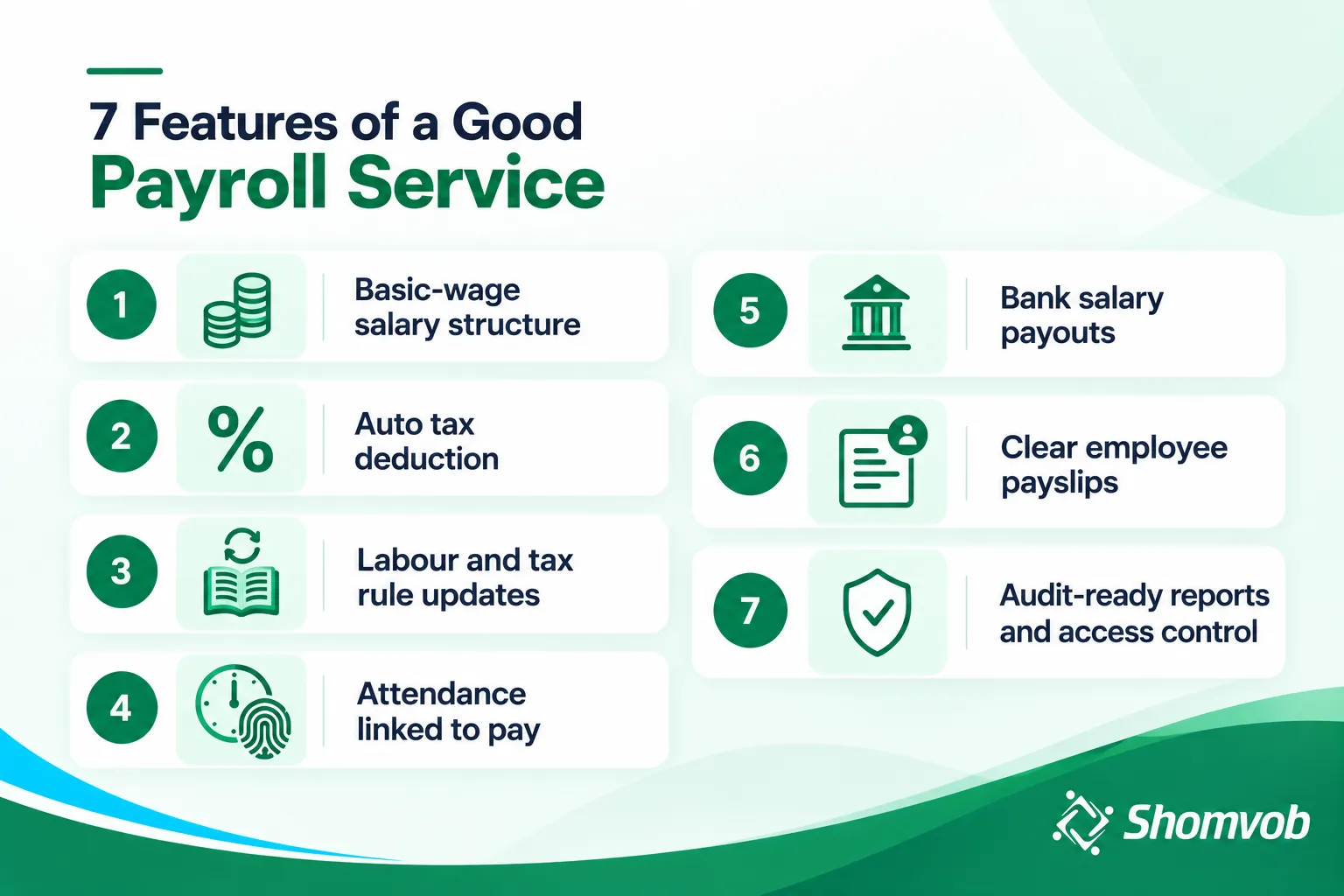
These features matter most to Bangladeshi employers because they align with how pay, tax, and labour rules work here. Each one comes with a question you can put to the provider.
1. A Salary Structure Built Around Basic Wage
In Bangladesh, overtime, festival bonus, provident fund contributions, and gratuity are generally computed on basic wage rather than gross pay. That makes the basic wage the basis for most of the calculations.
A system with a single "salary" figure pushes you back into spreadsheets. Look for separate basic, house rent, medical, and conveyance fields, with rules that pick the right base for each payment.
Ask the provider: Can you show how a festival bonus is calculated from basic wage?
2. Automatic Tax Deduction at Source
The employer deducts income tax from salary every month, based on the employee's estimated income for the year. A mid-year bonus, promotion, or new hire change that affects the estimate.
The system should recalculate whenever pay changes. Depositing the tax and filing the return are separate duties with separate deadlines, so you should also keep the records you need for both.
Ask the provider: What happens to an employee's tax deduction when we pay a bonus mid-year?
3. Updates When Labour and Tax Rules Change
Parliament and the interim government made about ninety changes to the Bangladesh Labour Act between 2025 and 2026, through a 2025 ordinance and a 2026 Act. Tax figures also move with each Finance Act.
A provider that leaves updates to you turns every change into a manual project. The stakes are real: non-payment of the minimum wage can result in a fine of BDT 50,000 to 100,000 or up to one year in prison.
Ask the provider: Who updates the system when the law changes, and how quickly?
4. Attendance, Leave, and Overtime Linked to Pay
Most payroll errors start before the calculation. Late sheets, missed approvals, and retyped totals all result in incorrect payments.
Look for attendance that arrives from biometric devices or branch apps, with approved leave and overtime flowing straight into the pay run. This matters most for businesses with branches or shift-based staff.
Ask the provider: Which attendance devices do you connect to, and how do you handle unapproved overtime?
5. Salary Disbursement Through Your Own Banks
A payroll run is only finished when the money reaches the accounts. Check that the service produces a bank-ready file or pays directly for the banks your employees use.
You also want a record of each payment batch so you can quickly trace a failed transfer.
Ask the provider: Which banks do you support, and how are failed transfers handled?
6. Clear Payslips for Every Employee
A payslip should show earnings, each deduction, and the net amount. When employees can read it, they raise fewer questions with HR.
Look for payslips by email or through an employee portal, ideally in Bangla and English.
Ask the provider: Can employees view and download past payslips themselves?
7. Audit-Ready Reports and Controlled Access
Payroll data includes salaries, bank details, and tax records. You need reports that stand up to an audit, and controls on who can see what.
Role-based access and a change log cover both. The law now adds a third layer, because Parliament passed the Personal Data Protection Act 2026 in April 2026, replacing the earlier ordinance.
A provider that runs your payroll handles your employees' personal data, so how it protects that data matters to you as well.
Ask the provider: Can I see a log of who changed a salary figure, and when?
Managed Payroll Service or Payroll Software?

Before you compare providers, decide how you want payroll to be run. The same seven features apply either way, but the work is split differently, and that choice decides what your team still does each month.
Payroll software: Your team runs the cycle inside the system. You keep control, and you need a named person to own it.
Managed payroll service: The provider runs the cycle for you. Your workload drops, but you depend on the provider's accuracy and reporting.
If you have a trained payroll owner and clean data, the software usually fits. If payroll is a one-person side task, a managed service reduces risk.
Whether to outsource HR or keep it in-house is a wider question, and your answer there should guide this choice.
Questions to Ask Before You Sign With a Payroll Provider

Demos show the best case, with tidy data and no deadline pressure. What you need to know is how a provider handles your own employees, your branches, and your payroll week. These questions help you find out before you sign:
Can you run last month's payroll on my data so I can compare results?
How long does moving from spreadsheets take, and who does the data work?
What support do I get during payroll week?
Where is our data stored, and who can access it?
How are errors corrected, and how fast?
Can I export my data if I leave?
If you are comparing named providers, this list of payroll outsourcing companies in Bangladesh is a useful starting point.
Where Shomvob's Payroll Services Fit
Shomvob's managed staffing and payroll service runs payroll for the employer, along with attendance tracking and compliance-related processes. Its service page says the default cycle is monthly, with weekly or bi-monthly options.
It also says a legal team checks contracts and payroll processes against the Labour Act, AIT, and VAT.
Employers who prefer to run payroll in-house can use Shomvob's HRM software. Its product page lists automated salary runs with tax and statutory deductions, payslips, and a one-click bank disbursement file. New employers get a 30-day free trial with no credit card required.
Choosing a Payroll Service in Bangladesh Based on Where Your Payroll Risk Sits
A payroll service earns its place when it removes the steps where mistakes start: retyped attendance, hand-calculated taxes, and manual bank file transfers.
For Bangladeshi HR managers, founders, and business owners, the decision comes down to how accurate your pay calculations must be, how often your business's rules change, and how much of the cycle your team can run itself. Keep these points in mind:
Check basic-wage logic and tax deduction first, because they cause most errors.
Make labour and tax updates the provider's job, not yours.
Link attendance and leave to pay so nobody re-types totals.
Test a run on your own data before you sign.
Name a payroll owner on your side, even if you choose a managed service.
To see how payroll would run on your own employee data, ask Shomvob about managed payroll. The team can help you decide between a managed service and software, and plan the move from spreadsheets.
Frequently Asked Questions
What Does a Payroll Service Do?
It calculates each employee's pay from attendance, leave, and salary terms, applies deductions and tax, pays through the bank, and issues payslips and records. Some providers run the whole cycle for you, and others give you the system to run it yourself.
Is Payroll Software the Same as a Payroll Service?
Not always. Software gives your team the tools to run payroll, while a managed service has the provider run it for you. Many vendors offer both, so check which one a quote covers.
How Much Does a Payroll Service in Bangladesh Cost?
It depends on the number of employees, the features included, and whether the provider runs the cycle for you. Ask for pricing in BDT in writing, and check what is included in the base price.
Can a Payroll Service Handle Employees Across Several Branches?
Yes, if it supports branch-level attendance and reporting. Ask how it handles different shift patterns and whether each branch manager sees only their own team.
Do I Still Need HR Staff if I Use a Managed Payroll Service?
Yes. Someone on your side still has to approve attendance, leave, and joiner or leaver changes before each run. A managed service reduces the workload but doesn't remove the need for an owner.
How Often Do Payroll Rules Change in Bangladesh?
Tax figures can change with each Finance Act, and labour rules were changed extensively in 2025 and 2026. Ask your provider to confirm in writing how updates are handled.