
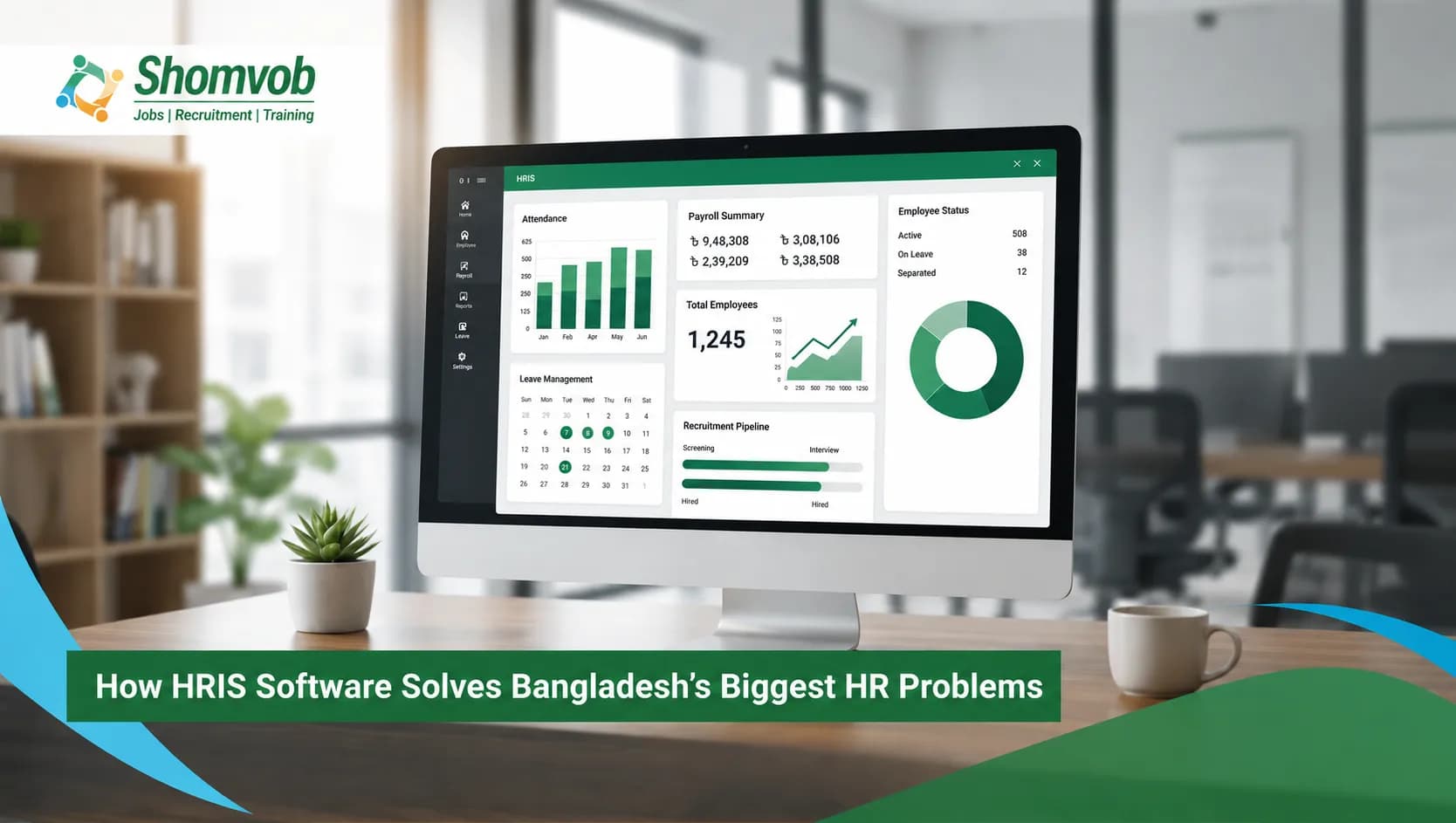
Many businesses in Bangladesh still rely on spreadsheets, paper records, and manual HR processes that lead to payroll mistakes, attendance disputes, compliance risks, and hiring delays. This article explores how HRIS software helps companies automate HR operations, improve workforce management, and solve some of the country’s biggest HR challenges.
Managing people is hard. Managing hundreds or thousands of people without the right tools is even harder.
Businesses across Bangladesh are feeling this pressure every single day. They deal with missing attendance records, delayed salaries, compliance headaches, and hiring bottlenecks that slow down everything.
And most of these problems are not caused by bad intentions. They are caused by old, manual systems that were never built to handle modern workforce needs.
Bangladesh has over 71 million working-age people. Around 700,000 businesses are actively trying to find and manage the right employees.
Yet most HR operations still run on spreadsheets, paper registers, and phone calls. That gap between the size of the workforce and the tools being used to manage it is where the biggest problems live.
This article will walk you through what HRIS software actually is, what HR problems it solves in the Bangladesh context, and how your business can start using it the right way. Whether you run a garment factory, a logistics company, or a growing startup, this guide is for you.
What Is HRIS Software and Why Does It Matter
HRIS stands for Human Resource Information System. It is a software platform that brings all your HR tasks into one place. Think of it as a digital command center for everything related to your workforce.
You might be wondering what that actually includes. At its core, HRIS software handles employee records, attendance tracking, payroll processing, leave management, recruitment, and compliance reporting. Some systems also include performance management and training modules.
The Basic Functions of an HRIS
Centralized employee database with personal, contract, and salary details
Automated attendance and shift management
Leave application and approval workflows
Payroll calculation with tax and deduction handling
Compliance reports aligned with labor law requirements
Recruitment and onboarding tracking
Why Bangladesh Businesses Need It Now
Bangladesh's workforce is growing and getting more complex. The Bangladesh Labor Act 2006, recently updated through the Labor Amendment Ordinance 2025, places specific requirements on employers around record-keeping, overtime calculation, and worker rights.
Manual systems make it nearly impossible to stay compliant at scale.
Here is where things get interesting. According to research by the Bangladesh Institute of Development Studies (BIDS), industrial sectors across Bangladesh are operating with a 30% skills gap, and workforce mismatches are cutting productivity significantly across the board. HRIS software directly addresses these losses.
The Biggest HR Problems in Bangladesh
Before looking at solutions, you need to understand the problems clearly. These are not abstract issues. They are real challenges that business owners and HR managers describe repeatedly across industries.
Problem 1: Inaccurate Attendance and Timesheet Records
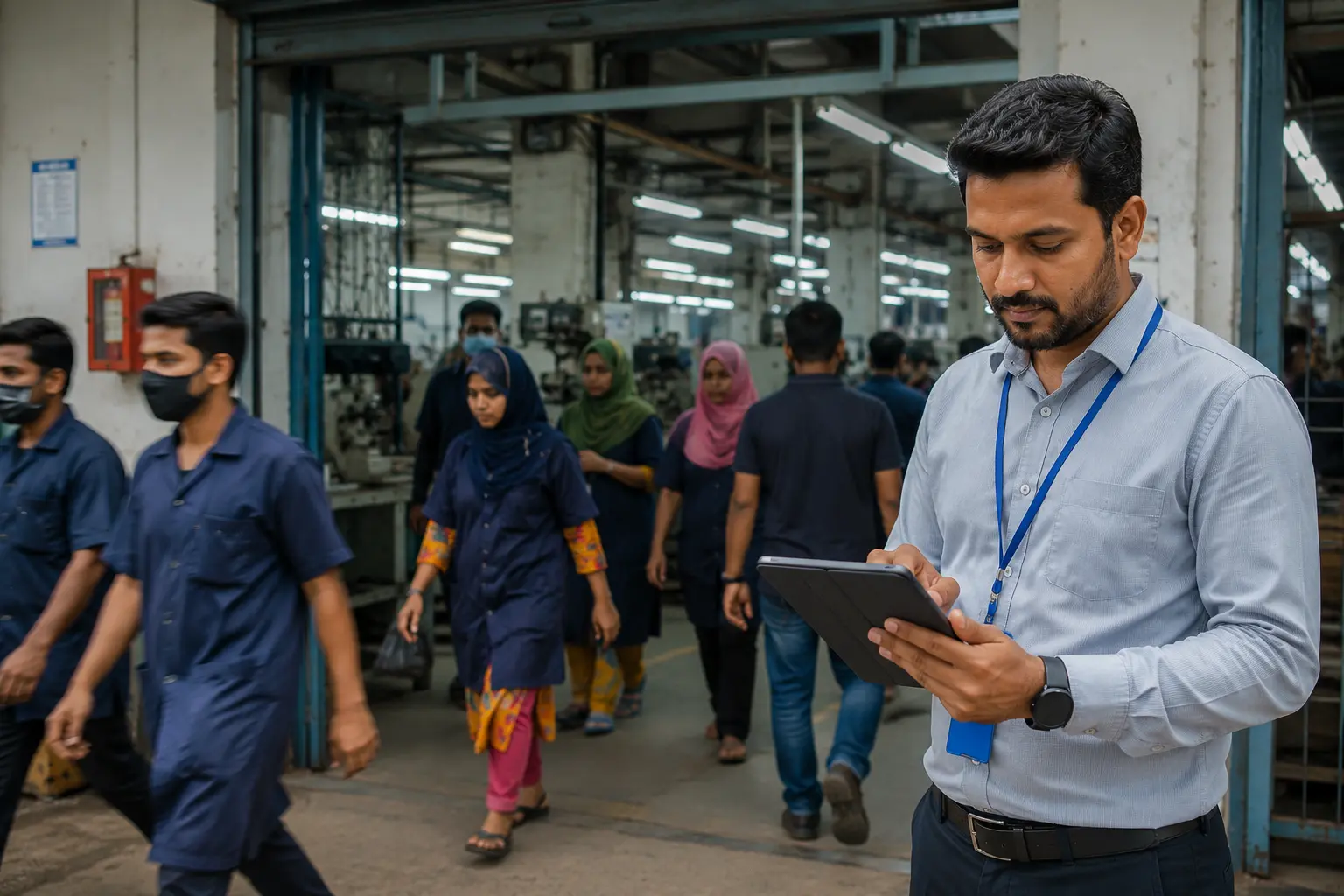
Many factories and businesses still use paper punch cards or basic biometric systems that do not connect to payroll. Workers clock in and out, but the data sits in isolation.
HR staff then manually transfer that data into payroll sheets. Errors are common. Disputes are common. Time is wasted.
Think about this. If you have 200 workers and even 5% of attendance records are wrong each month, that is 10 people getting incorrect pay. Over a year, that creates legal exposure, worker dissatisfaction, and administrative burden.
Problem 2: Payroll Delays and Calculation Errors
Bangladesh's Labor Act requires timely wage payment. But payroll in many businesses is calculated manually, often over several days.
Overtime rates, allowances, deductions, and tax calculations all add complexity. One missed formula in a spreadsheet affects dozens of employees.
Problem 3: Poor Compliance Tracking
The Labor Amendment Ordinance 2025 introduced updated requirements around worker welfare, leave entitlements, and reporting. Businesses that cannot generate accurate compliance reports quickly are at risk during inspections.
Many HR teams admit they cannot produce clean records on demand.
Problem 4: Weak Recruitment Pipelines
Around 700,000 businesses in Bangladesh struggle to hire the right people. The hiring process for blue-collar and silver-collar workers often depends on word of mouth or walk-ins.
There is no system to track applications, shortlist candidates, or maintain a talent pool for future vacancies.
Problem 5: No Central Employee Records
Employee information is scattered. Contracts are in one folder. Medical records are somewhere else. Salary history is in a spreadsheet that no one has updated in months.
When an employee leaves, information disappears with them. When audits happen, finding documents becomes a crisis.
Problem 6: High Turnover With No Root Cause Analysis
Bangladesh's industrial and service sectors see high employee turnover. But most businesses do not track exit data, performance trends, or engagement signals.
They only notice the problem when it is too late. HRIS software creates visibility into patterns that manual systems cannot capture.
How HRIS Software Solves Each Problem
Now, let us focus on the solutions. HRIS software does not just digitize old processes. It redesigns how HR actually works. Let's explore below:
Solving Attendance Problems With Automation
A good HRIS connects your attendance hardware or mobile check-in system directly to the platform. Data flows in real time. Shift records are automatically matched against scheduled hours. Overtime is flagged. Discrepancies are highlighted before payroll runs. HR staff spends minutes reviewing instead of hours recalculating.
Field observations from garment sector HR managers show that automated attendance reduces payroll disputes significantly within the first few months of implementation. The time saved by HR teams flows directly into higher-value work.
Making Payroll Accurate and On Time
HRIS payroll modules are built around local compliance. They calculate basic wages, overtime at the correct multiplier, festival bonuses, and tax deductions automatically.
Once attendance data is confirmed, payroll can be processed in hours, not days. Payment reports are generated instantly for management review.
You should be careful here. Not all HRIS platforms are configured for Bangladesh's specific pay structures and allowance categories. Always verify that the system you choose supports local compliance requirements before buying.
Automating Compliance Reporting
A well-designed HRIS generates compliance reports on demand. Labor inspection reports, overtime summaries, leave records, and worker welfare data are all stored and retrievable. Some platforms alert HR teams when a compliance deadline is approaching or when a worker's leave balance is about to expire.
This is directly relevant to the Labor Amendment Ordinance 2025, which increased scrutiny on worker records and welfare documentation.
Building a Structured Recruitment Process
HRIS recruitment modules let you post jobs, collect applications, and track candidates through each stage of the hiring process. You can shortlist based on criteria, schedule interviews, and keep a searchable database of past applicants. For high-volume hiring common in manufacturing and logistics, this is a game-changer.
Platforms like Shomvob, which have processed over 6 million job applications and connected hundreds of businesses with blue-collar and silver-collar workers, demonstrate how technology transforms hiring at scale in Bangladesh.
Centralizing Employee Records
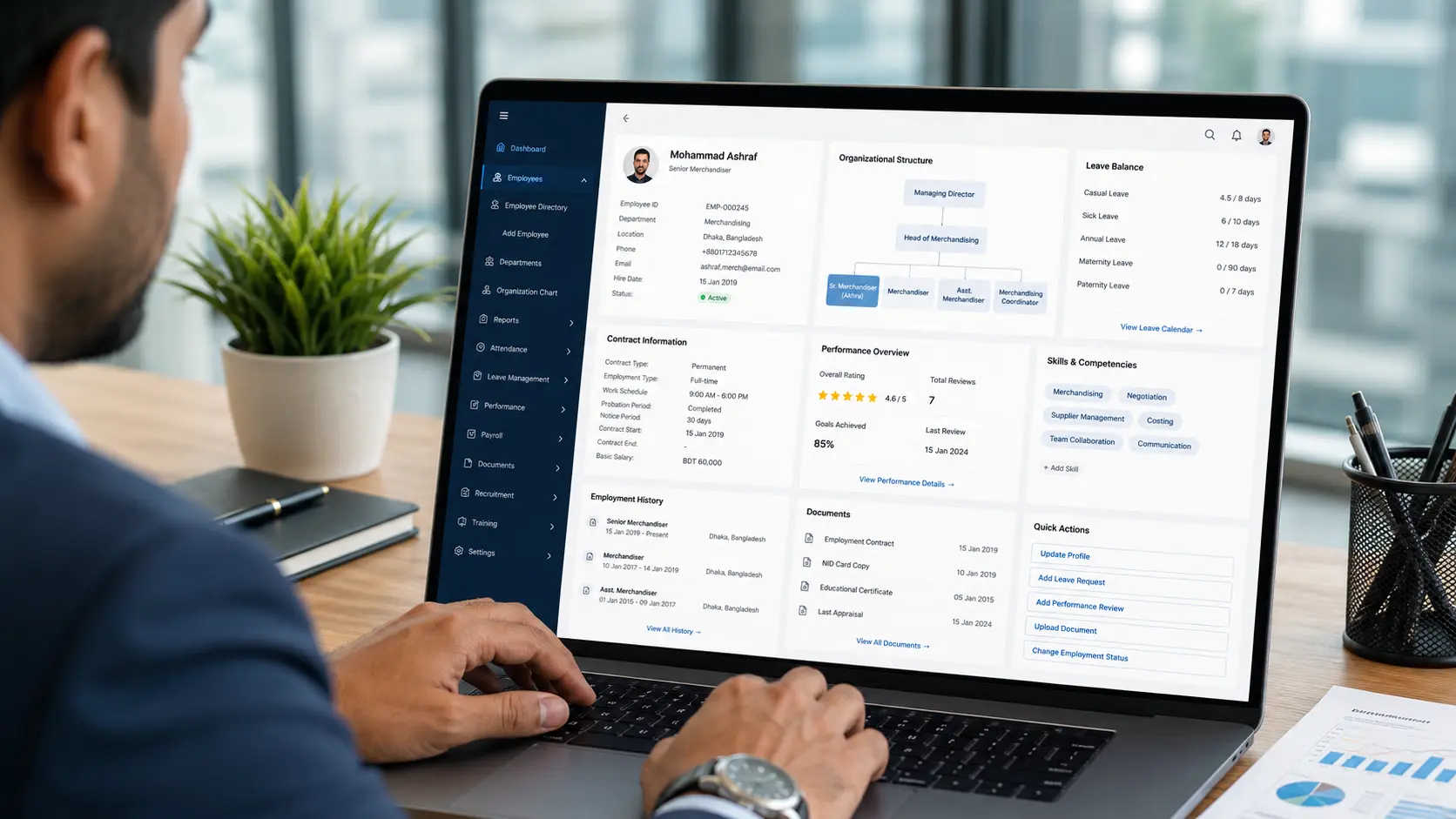
Every employee in an HRIS has a complete digital profile. Joining date, contract type, salary history, attendance record, performance notes, leave taken, and training completed are all in one place.
Access is controlled by role. Data is backed up automatically. When you need a document, you find it in seconds.
Reducing Turnover Through Data Visibility
HRIS platforms track performance trends, absence patterns, and engagement signals over time. Managers can see which teams have high absence rates or which individuals have not received a review in six months.
Early intervention becomes possible. Exit interview data can be logged and analyzed. Over time, patterns become clear, and turnover becomes manageable.
HRIS Software Comparison: Key Features to Evaluate
Feature | Basic HRIS | Mid-Range HRIS | Full-Suite HRIS |
Employee Database | Yes | Yes | Yes |
Attendance Tracking | Manual Input | Semi-Automated | Fully Automated |
Payroll Processing | Basic | Local Compliance | Advanced + Tax |
Leave Management | Yes | Yes | Yes |
Recruitment Module | No | Limited | Full ATS |
Compliance Reporting | No | Basic | Comprehensive |
Performance Management | No | Limited | Full Module |
Mobile Access | No | Limited | Full App |
Bangladesh-Specific Setup | Varies | Varies | Must Verify |
What to Look For in HRIS Software for Bangladesh
Have you thought about what makes an HRIS actually work in the Bangladesh context versus anywhere else? The answer lies in localization, not just features.
Bangladesh-Specific Requirements
Support for local pay structures, including festival bonuses, overtime rules under the Labor Act, and provident fund deductions
Interface available in Bangla or bilingual Bangla-English
Compliance templates aligned with the Bangladesh Labor Act 2006 and the Labor Amendment Ordinance 2025
Customer support is accessible locally, not just through international ticketing systems
Scalability for Growing Businesses
Your business today may have 100 workers. In two years, it may have 500. Choose an HRIS that can grow with you without requiring a full system change. Cloud-based platforms handle this better than on-premise solutions.
Ease of Use for Non-Technical HR Teams
Most HR teams in Bangladesh's industrial sector are not software engineers. The platform needs to be simple, clean, and trainable within a few days. Overly complex interfaces reduce adoption and defeat the purpose.
Integration With Hiring Platforms
If your business uses an external job platform for recruitment, your HRIS should be able to connect with it or import data easily. This avoids double entry and keeps your talent pipeline clean.
How to Implement HRIS Software in Your Business
But hang on, there is more to it. Buying HRIS software is only the beginning. Implementation is where most businesses either succeed or struggle. Here is a practical checklist to follow:
Audit your current HR data. Before migrating to any system, clean your existing employee records. Remove outdated entries. Standardize formats for dates, names, and salary figures.
Define your HR processes first. Map out how attendance is tracked, how payroll flows, and how leave is approved before setting up the system. Software should follow your process, not force a new one without understanding.
Assign a system administrator. Someone in your HR team needs to own the platform. They handle setup, user access, and day-to-day troubleshooting.
Run a pilot with one department. Start with 20 to 50 employees before rolling out to everyone. Catch errors and adjust before they affect your entire workforce.
Train your HR team thoroughly. Most platforms offer training sessions. Use them. Budget at least two weeks for your team to get comfortable.
Migrate data carefully. Upload employee data in stages. Verify each batch before moving to the next.
Set up compliance reports from day one. Do not wait until an inspection to test your compliance reporting. Run a test report in the first month.
Collect feedback after 90 days. Ask your HR team and line managers what is working and what is not. Most platforms allow configuration adjustments.
Review payroll accuracy for the first three months—Cross-check HRIS-generated payroll against your previous system before fully switching over.
Plan for ongoing updates. Labor laws change. Your HRIS provider should release updates to keep the platform compliant. Confirm this before signing any contract.
The Business Case for HRIS in Bangladesh
Let us break it down with numbers. Businesses that implement HRIS software typically see the following outcomes within the first year.
Payroll processing time reduced by 60 to 70%
Attendance disputes dropped by 35 to 45%
Compliance incident rate has reduced significantly
HR staff productivity improved as manual tasks were automated
Employee satisfaction increased due to accurate and on-time pay
Bangladesh has 77.3 million internet users as of 2024. Mobile penetration is high even among blue-collar workers. HRIS platforms with mobile access allow workers to check their pay slips, apply for leave, and update personal information from their own phones.
This is not a future vision. It is available now.
Conclusion
HRIS software is not a luxury for large corporations. It is a practical tool that solves real problems your business is likely already facing. Attendance errors, payroll delays, compliance gaps, and weak hiring systems all have direct solutions through the right platform.
Bangladesh's workforce is too large and too important to manage with outdated tools. The businesses that digitalize their HR operations now will hire faster, pay accurately, stay compliant, and retain workers better than those that wait. The technology exists, it is accessible, and the return on investment is clear.
Start by identifying your biggest HR pain point today. Then find a professional HRIS platform that solves it directly, is built for the Bangladesh context, and can grow with your business.
Frequently Asked Questions
1. What does HRIS stand for?
HRIS stands for Human Resource Information System. It is software that manages all HR functions, including employee records, attendance, payroll, leave, and compliance in one platform.
2. Is HRIS software suitable for small businesses in Bangladesh?
Yes. Many HRIS platforms offer tiered pricing and can be used by businesses with as few as 20 to 50 employees. The benefits in time savings and accuracy apply regardless of company size.
3. How does HRIS software help with Bangladesh Labor Law compliance?
A good HRIS stores all employee records, calculates wages and overtime according to the Bangladesh Labor Act, and generates compliance reports that can be produced during inspections without manual preparation.
4. Can HRIS software handle Bangla language records?
Some platforms offer Bangla language support or bilingual interfaces. This is an important factor to check before choosing a system, especially if your HR team or workers are more comfortable in Bangla.
5. What is the difference between HRIS and payroll software?
Payroll software handles only salary calculations and payment processing. HRIS is a broader system that includes payroll as one module among many, alongside attendance, leave, recruitment, and performance management.
6. How long does it take to implement HRIS software?
A typical implementation for a business with 100 to 500 employees takes four to eight weeks. This includes data migration, team training, and a pilot phase before full rollout.
7. Does HRIS software work for factory and blue-collar workforce management? Yes. HRIS platforms can be configured for shift-based work, overtime-heavy environments, and high-volume workforce management common in garment, logistics, and manufacturing industries in Bangladesh.
8. What happens to our data if we switch HRIS providers?
Most reputable HRIS platforms allow you to export your data in standard formats such as CSV or Excel. Always confirm data portability and export rights before signing a contract.
9. Is cloud-based HRIS software safe for sensitive employee data?
Cloud-based platforms use encryption and role-based access controls to protect data. They are generally more secure than local spreadsheets or paper records. Look for platforms with clear data privacy policies.
10. How much does HRIS software typically cost in Bangladesh?
Pricing varies widely. Entry-level platforms may cost BDT 3,000 to 10,000 per month for small teams. Mid-range and enterprise systems can run higher. Many providers offer free trials or demo periods, which you should use before committing.