
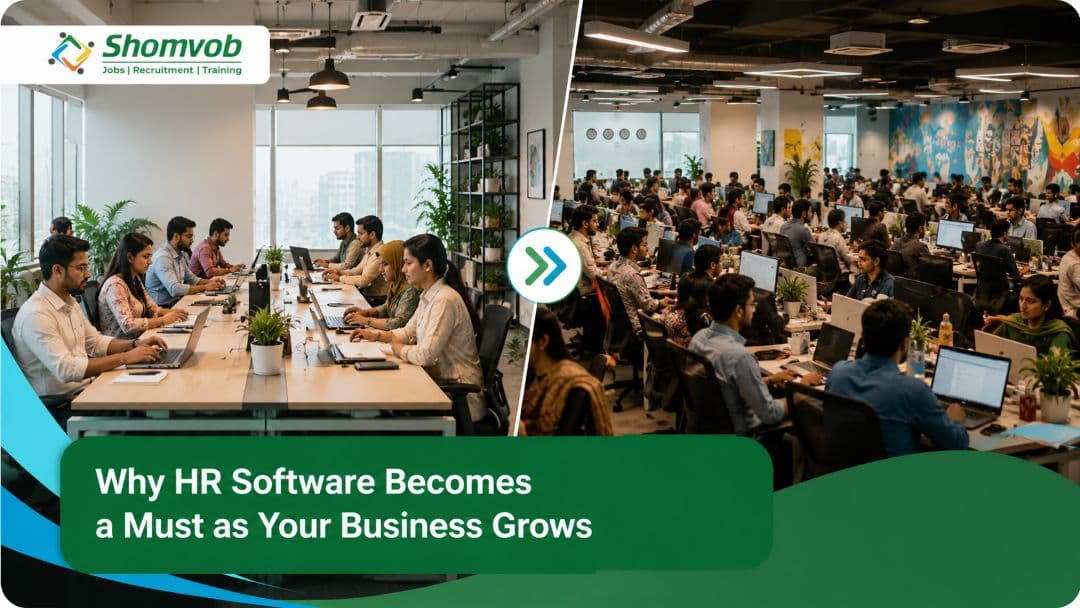
Most businesses hit a breaking point between 20 and 40 employees, where payroll errors, messy attendance, and inconsistent onboarding start piling up. Here's why HR software becomes essential as growth exposes every shortcut, and what to look for at each stage.
Ask any business owner in Dhaka who went from 15 staff to 60 in under two years, and most of them will tell you the same thing. The product side scaled fine. The operations side figured itself out.
But HR? HR became a daily headache that nobody saw coming.
Payroll errors started showing up. Attendance records stopped making sense. New joiners sat around for days waiting for someone to tell them what to do. And the person running HR was the same one who used to manage it when the team was small enough to fit in a single office.
Growth can be exciting. But it has a habit of exposing every shortcut your HR process was built on.
The Spreadsheet Phase and Why It Always Ends Badly
Most businesses start with spreadsheets. That is completely fine. In the early days, when your team fits in one room and everyone knows everyone, a shared Excel file and a WhatsApp group can genuinely get the job done.
But that same setup that felt efficient at 10 employees becomes genuinely dangerous at 35.
Most growing businesses cross the spreadsheet breaking point somewhere between 20 and 40 employees, and when they do, the cracks tend to appear all at once.
What Breaking Down Actually Looks Like
The signs are rarely dramatic at first. They creep in slowly.
Payroll takes longer each month, and someone always finds an error after the fact
New hires start without complete paperwork or a consistent onboarding experience
Attendance records are either missing or stored in three different formats
Managers handle leave requests differently across departments
Nobody has a clean number for actual headcount on any given day
When growth outpaces HR systems, even simple tasks become chaotic. Onboarding breaks down, compliance becomes an afterthought, payroll mistakes increase, and HR becomes reactive rather than proactive.
Sound familiar? All of it is fixable once you know what you are actually dealing with.
Growth Amplifies Every Weakness in Your HR Setup
Here's a truth worth sitting with for a moment: Growth does not create new HR problems. It magnifies those that were already hiding beneath the surface.
According to research, growth rarely breaks HR systems overnight. More often, the cracks show up slowly until the workarounds become the process itself.
A manual attendance system that was slightly unreliable at 15 employees becomes a compliance risk at 60. A payroll process that used to take 2 hours for 20 people now takes 2 full days for 80.
The 50-Employee Tipping Point
There is a well-documented pattern in HR circles sometimes called the 50-employee breaking point. At this stage, most companies respond by hiring more HR staff to manage the chaos.
This solves the symptom but not the problem. Headcount gets added to compensate for infrastructure that does not scale, and the underlying fragmentation remains.
More HR staff without better systems just means more people struggling with the same broken process. The fix is not more people. The fix is better infrastructure.
Why This Hits Bangladeshi Businesses Particularly Hard

The global growth challenge is real, but it takes on a distinct shape in Bangladesh. A few things are happening at the same time, making the timing more pressing than ever.
SMEs Are the Backbone of the Economy
According to the Bangladesh Bureau of Statistics, SMEs account for 25% of national GDP and 80% of non-agricultural employment.
These are not peripheral players. They are the foundation of the economy. And a large share of them are growing fast right now, adding headcount while still running on the same manual processes they started with.
The IT Sector Is Scaling at Speed
Bangladesh's IT and IT-enabled services sector is expected to reach USD 5 billion in market size by the end of 2025, with annual growth rates exceeding 40%.
That kind of expansion brings aggressive hiring, rapid onboarding cycles, and multi-location teams. None of that scales well on paper registers and manual payroll.
Compliance Does Not Wait for You to Catch Up
Bangladesh Labor Act requirements, NBR tax slab updates, provident fund rules, and festival bonus timelines do not pause because your HR team is overwhelmed. The faster a business grows, the more regulatory exposure it faces.
Compliance requirements multiply as companies expand their workforce, enter new markets, or increase operational complexity. They go beyond simple headcount increases and demand stronger HR expertise, upgraded policies, and scalable systems.
What HR Software Actually Does at Each Growth Stage

Let's break it down by where your business actually is, because the right tool depends entirely on your current size and pain points.
Early Stage (10 to 30 Employees)
At this stage, the priority is getting the basics right before bad habits solidify. You need clean employee records, an attendance system that does not rely on manual sign-in, and a payroll process that takes hours rather than days.
The goal here is not sophistication. It is consistency. In a business of this size, the right answer is often simpler than expected.
A core HRIS, a reliable payroll connection, a basic applicant tracking process, standardized forms, and a disciplined approach to documentation go a long way before anything else is needed.
Growth Stage (30 to 100 Employees)
This is where HR software shifts from a convenience to a genuine operational necessity. Hiring volume increases, onboarding needs to be standardized, and managers in different departments start making inconsistent decisions without centralized oversight.
Employees expect quick onboarding, accurate payroll, clear policies, and easy access to information. According to HRwebsoftware, manual HR processes often fail to meet these expectations.
Leave requests may take days to be approved, and over time, these small frustrations add up, leading to disengagement, lower productivity, and higher turnover.
Scale Stage (100 Employees and Beyond)
At this point, HR software is not optional by any measure. Multi-location management, performance review cycles, succession planning, and real-time workforce analytics all require a system rather than a spreadsheet.
The 2026 HR Trends Report identifies three forces hitting growing businesses simultaneously: AI integration demands, increasingly complex compliance requirements, and upskilling pressure as teams scale rapidly.
The Real Cost of Delaying the Switch
This is where many founders and HR leads miscalculate. The instinct is to wait until growth is "stable enough" before investing in better systems. That instinct is expensive.
What Gets Delayed | What It Actually Costs |
Fixing payroll errors | Employee disputes, trust erosion, and back payments |
Standardizing onboarding | Inconsistent new hire experiences, early attrition |
Automating compliance tracking | Penalties, regulatory exposure, and scrambled budget revisions |
Centralizing attendance | Hours of manual reconciliation every pay cycle |
Building performance frameworks | Unclear expectations, manager-employee friction |
The best time to fix HR infrastructure is before it breaks. According to infinitihr, the second-best time is right now.
What to Look for in HR Software When You Are Growing
Not every platform is built for a business mid-growth. Some are designed for startups with flat structures. Others are so complex that a dedicated IT team is needed just to configure them. Neither extreme helps a company that is moving fast.
Features That Matter Most at This Stage
Here's where things get practical. These are the capabilities that tend to make the biggest difference for growing businesses.
Payroll automation with local tax and compliance rules built in
Mobile-first attendance and leave management that workers actually use
Onboarding workflows that can be standardized and repeated at scale
Role-based access so managers can see their teams without touching payroll data
Reporting dashboards that give leadership real-time headcount and cost visibility
Integration with local banking and mobile financial services for payroll disbursement
The Bangladesh-Specific Layer
If you are running a business here, a generic global platform will leave gaps. NBR tax slabs, provident fund calculations, gratuity rules, and festival bonus timelines need to be wired into the payroll engine, not handled by someone manually adjusting a spreadsheet after every budget announcement.
This is exactly where Shomvob's HRIS is built to serve growing Bangladeshi businesses, with local compliance baked in from the ground up rather than bolted on to a global template.
Signs Your Business Has Already Outgrown Its Current Setup
A few honest questions worth sitting with before moving on.
Does payroll take more than a day to process each month
Have employees raised concerns about incorrect pay or missing overtime
Do different managers track attendance in different ways
Are new hires waiting more than a week for access, paperwork, and basic orientation
Does your leadership team have to ask HR for a headcount number rather than seeing it live
If more than two of those are true right now, the setup has already been outgrown. The question is just how long to let it run before fixing it.
Making the Transition Without Disrupting the Business
You might ask, will switching to an HR platform require months of disruption and a large implementation project?
The short answer is no, if the right platform is chosen for the stage the business is actually at. Mid-sized companies often have the agility to implement new platforms without the roadblocks that slow down larger enterprises.
They can choose tools that fit their culture, workflows, and growth plans more freely than both early-stage startups and large corporations.
A few practical things that help the transition go smoothly:
Start with attendance and payroll before layering on performance or training modules
Run a short pilot with one department before a full rollout
Migrate employee data in a structured way rather than all at once
Train managers first, since they are the ones employees turn to when something feels unfamiliar
Final Thoughts
Growth is the goal for every business. But growth without the systems to support it creates exactly the kind of chaos that slows everything down at the worst possible time.
HR software is not about adding technology for the sake of it. It is about making sure that as your team grows, your processes keep pace. Payroll stays accurate, compliance stays clean, and every new hire gets the same consistent experience rather than a different one depending on who happened to be in the office that day.
If your business is growing and the HR side of things is starting to feel harder than it should, take a look at what Shomvob offers for Bangladeshi businesses at every stage of that growth journey.
Frequently Asked Questions
1. At what company size should a business start using HR software?
Most businesses start feeling the pressure between 20 and 40 employees, but getting a proper system in place around the 15 to 20 mark is far less painful than scrambling to fix broken processes after the fact.
2. Is HR software affordable for small and growing businesses in Bangladesh? Most modern platforms use a per-employee monthly subscription model, which makes the cost proportional to headcount. For most growing businesses, the cost of errors and compliance penalties from manual processes is significantly higher.
3. What is the most common mistake businesses make when switching to HR software?
Trying to implement everything at once rather than starting with the most urgent pain points, usually payroll and attendance, and building from there.
4. Does HR software work for businesses with both white-collar and blue-collar employees?
Yes, and for businesses managing both, it matters even more. Factory-level attendance tracking, shift management, and wage calculation are all part of good HRM platforms alongside standard office HR functions.
5. How does HR software help with Bangladesh Labor Act compliance specifically?
A platform built for the local market will include NBR tax slabs, provident fund rules, gratuity calculations, and leave entitlements, all coded directly into the payroll engine, so compliance adjustments occur automatically rather than requiring manual intervention after every policy update.