
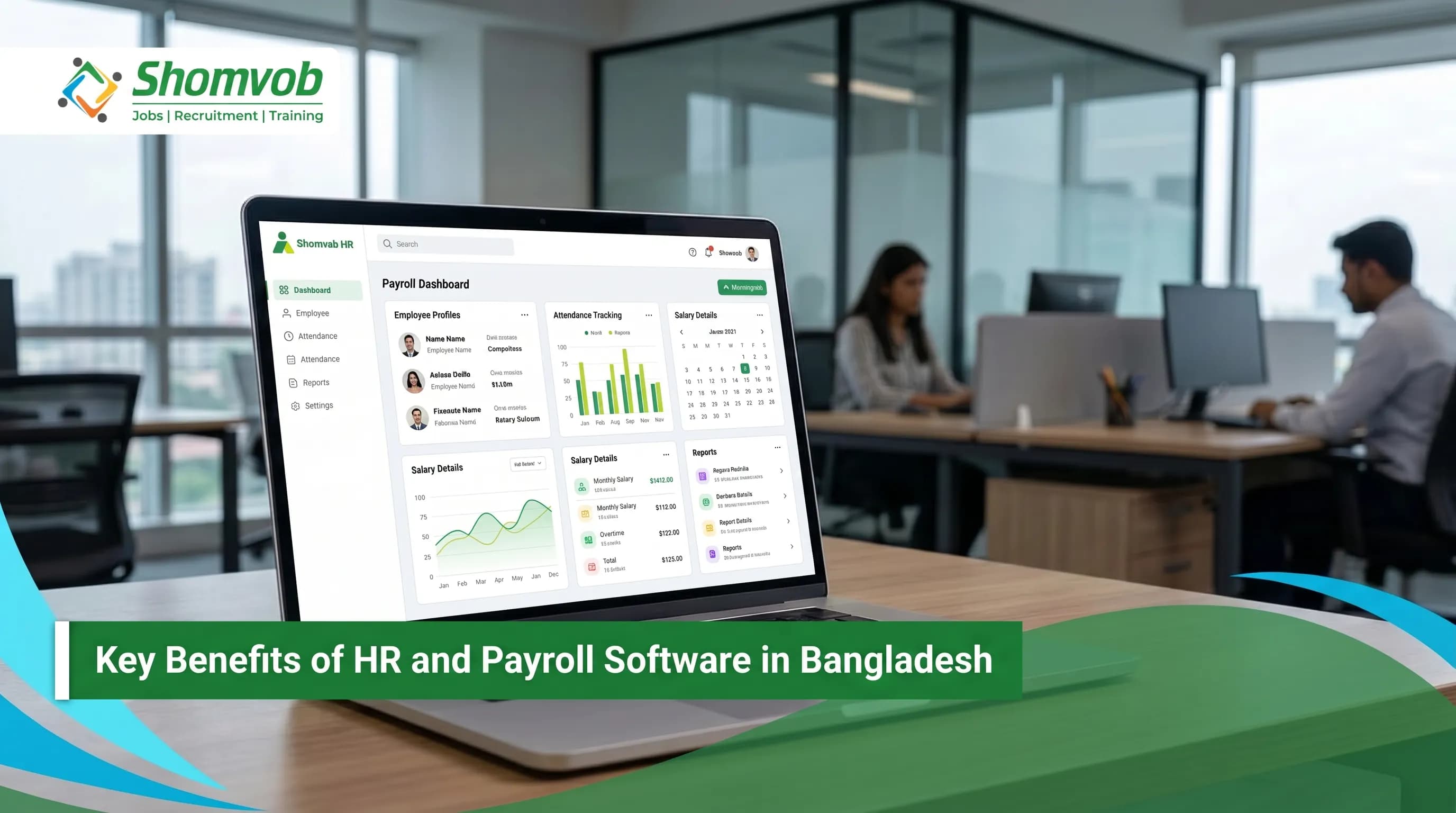
Managing HR and payroll manually can slow down your business and increase errors. In Bangladesh, more companies are moving to digital systems to improve accuracy, save time, and stay compliant. This guide explains how HR and payroll software helps you manage employees more efficiently and support business growth.
Running a business in Bangladesh is not easy. You are managing people, tracking attendance, calculating salaries, and staying compliant with labor laws all at once.
HR and payroll software takes that burden off your shoulders. It handles the routine work so your team can focus on what actually matters.
Most business owners do not realize how much time and money they lose every month to manual HR processes. Attendance sheets go missing. Salary calculations take days. Festival bonuses get miscalculated.
By the time you notice a mistake, it has already caused a problem!
This guide covers the key benefits of HR and payroll software in Bangladesh and what it can mean for your business in 2026.
Why This Matters for Bangladeshi Businesses
Bangladesh has over 71 million working-age people. Businesses of all sizes, from small startups to large factories, are feeling the pressure to manage their workforce better. The old ways are simply not working anymore.
You might still be using spreadsheets or paper registers. Many businesses in Bangladesh are.
But here is the problem. Manual processes lead to errors, delays, and legal risks that cost you more in the long run.
The Real Cost of Manual HR Work
Think about your HR team for a moment. How many hours do they spend each month just calculating salaries?
For a company with 100 employees, that can easily take 15 to 20 hours every single month.
With HR software, that same job takes less than two hours. That is over 160 hours saved every year. Your team can use that time for hiring, training, and growing your business instead.
Bangladesh Is Going Digital Fast
Bangladesh had around 77 million internet users in 2024. Cloud-based tools are now accessible nationwide, not just in Dhaka. Businesses everywhere are moving to digital HR systems.
If your competitors are already using them, you cannot afford to wait.
What HR and Payroll Software Actually Does
You might be wondering what this software actually covers. Is it just about paying salaries on time?
Not at all.
HR and payroll software manage your entire workforce in one place. It tracks attendance, calculates salaries, handles leave requests, manages tax deductions, and keeps your records organized. Everything is connected, automated, and easy to access.
Key Functions of HR Software
Attendance tracking using biometrics, GPS, or mobile check-in
Automatic salary and tax calculations
Leave management with approval workflows
Provident fund and gratuity tracking
Festival bonus scheduling
Payslip generation for every employee
Employee self-service portal for routine requests
How It Is Different From Accounting Software
This is a question many business owners ask. Accounting software tracks your money. HR software manages your people. The difference matters.
In Bangladesh, payroll involves much more than just transferring salaries. You need to calculate overtime correctly, track festival bonuses, manage provident fund contributions, and follow the Bangladesh Labor Act 2006.
Accounting tools are not built to handle all of that automatically.
Key Benefits of HR and Payroll Software in Bangladesh
Let us get into the real benefits. These are the changes you will actually see after switching to HR and payroll software.
1. Save a Lot of Time on Payroll
Manual payroll for 100 employees takes 15 to 20 hours per month. With software, it takes less than 2 hours. The system does the calculations for you. It applies the right salary components, deductions, and tax rules every time.
You set the rules once. The software handles the rest.
2. Reduce Costly Payroll Errors
Here is where things get interesting. A small payroll mistake can create a big problem. A wrong tax deduction, a missed overtime payment, or an incorrect bonus can lead to employee disputes and even government penalties.
Research on HR automation shows that payroll errors drop by over 33% when businesses switch from manual to automated systems.
For your business, that means fewer disputes, less rework, and fewer legal risks.
3. Stay Compliant With Bangladesh Labor Law
This is one of the most important benefits. The Bangladesh Labor Act 2006 covers a wide range of employer obligations. Missing any of them can result in penalties of up to BDT 500,000.
Good HR software handles these requirements automatically. Here is a quick look at what it covers:
Compliance Requirement | What the Software Does |
Festival bonus (twice a year) | Calculates and schedules bonuses automatically |
Provident fund (7 to 8% of basic salary) | Tracks monthly contributions for the employer and employee |
Overtime at double rate | Calculates overtime beyond 48 hours per week |
WPPF (5% of profit for eligible companies) | Tracks contributions under BLA 2006, Chapter XV |
Salary payment within 7 days | Sends deadline alerts |
Income tax deduction at source | Applies the correct tax slab for each employee |
Now, let us get real. If you are managing all of this manually, a single missed step can cost you dearly! Software removes that risk entirely.
4. Track Attendance Accurately
Bangladesh has a very diverse workforce. You have office staff, factory workers, field sales teams, and delivery riders. Managing attendance across all these roles manually is a daily challenge.
Modern HR software supports multiple attendance methods. Biometric scanners work well on factory floors. GPS check-in works for field teams. Mobile apps work for office staff.
No matter where your employee is working, their attendance is recorded accurately. No manual entry needed.
You should be careful here. HR teams in mid-sized companies can spend over 30 hours a month just correcting attendance errors. The right software eliminates that problem at the source.
5. Give Employees Easy Access to Their Own Information
Have you thought about how many routine questions your HR team answers every day? Things like salary details, leave balances, and payslip copies take up real time.
With an employee self-service portal, your staff can check their own information directly. They can download payslips, apply for leave, view attendance records, and submit expense claims without contacting HR at all!
This one feature alone can noticeably reduce your HR team's daily workload.
6. Make Better Decisions With Live Data
Manual HR means you are always working with old information. Reports can take days to prepare. You only find out about problems after they have already grown.
HR software gives you live dashboards. You can see attendance patterns, leave usage, payroll costs, and overtime trends in real time.
If absenteeism suddenly rises in one team, you see it straight away. You can act before it turns into a bigger issue.
7. Grow Without Expanding Your HR Team
This is a benefit that many growing businesses in Bangladesh overlook. When you hire more people manually, you usually need more HR staff to manage them. With HR software, that is not the case.
A platform that supports bulk data uploads, multi-branch management, and role-based access keeps your HR operations efficient. Your team size can double or triple without your administrative work increasing at the same rate.
8. Keep Employee Records Safe and Organized
We know Paper files get lost, spreadsheets get damaged or deleted by mistake. Shared drives with no access control create real security risks.
Cloud-based HR software stores all your employee records in a secure, encrypted system. You can find any document in seconds.
You can also control exactly who has access to what. For businesses with multiple offices or HR staff, this kind of organization makes a real difference.
9. Connect Hiring and Payroll in One Flow
But hold on, there is more to it. One hidden cost in many Bangladeshi businesses is the time and effort required to hire someone and get them set up on payroll. This process often involves paperwork moving between departments for several days.
Platforms that connect recruitment, onboarding, and payroll in one system close that gap. A new hire can go from offer letter to first payslip without any paper changing hands.
Platforms like Shomvob were built with exactly this kind of connected workflow in mind. Starting as a job-tech platform before expanding into full HR management, Shomvob allows businesses to move from job posting to onboarding to payroll all in one place. For businesses that hire frequently, that kind of integration saves real time.
10. Manage Blue-Collar and Frontline Workers Properly
Most global HR software is built for office-based, salaried employees. But let us be honest. A large part of Bangladesh's economy runs on factory workers, delivery riders, NGO field staff, and retail teams.
The best HR software built for Bangladesh is designed for this reality. It handles shift scheduling, daily wage calculations, seasonal workforce changes, and industrial biometric attendance.
If your workforce is on the ground rather than at a desk, make sure the software you choose is built for that.
What to Expect When You Implement HR Software
You should be careful here because switching to HR software is not just a technical change. It affects how your whole team works. Here is a simple view of what the process looks like:
Phase 1: Moving Your Data
You will need to transfer your employee records, salary structures, and payroll history into the new system. Most vendors help with this step. Your HR team will need to check the data carefully before going live.
Phase 2: Training Your Team
Even great software fails if people do not know how to use it. Plan for two to four weeks of training. This is especially important for payroll staff and managers who handle leave approvals and expense sign-offs.
Phase 3: Running Both Systems Together
Run your old process and the new software side by side for at least one payroll cycle. This helps you spot any differences before you fully switch over. It takes extra effort, but it is always worth it.
How to Choose the Right HR Software for Your Business
Not every platform works for every business. Before you decide, ask yourself these questions:
Does it handle Bangladesh-specific rules like festival bonuses, provident fund, and WPPF?
Is there a mobile app for your employees?
Does it support your attendance method, whether biometric, GPS, or mobile?
Can it grow with your business as your team gets bigger?
Is there local customer support available when you need help?
Does it connect with your accounting or finance tools?
Is the pricing clear and fair for your team size?
If a vendor cannot answer these clearly during a demo, that is a sign to keep looking.
Conclusion
HR and payroll software is not only a tool to save time. In Bangladesh's current business environment, it is a practical necessity. It protects you from compliance risks, reduces errors, organizes your records, and gives your HR team the space to focus on people rather than paperwork.
The businesses growing fastest in Bangladesh right now are treating HR as a competitive advantage, not just an administrative task. The right software makes that shift possible.
Whether your team has 20 people or 2,000, the question is not whether you need HR software. The question is which one is built for the workforce you actually have.
Frequently Asked Questions
1. What is the biggest benefit of HR software for small businesses in Bangladesh?
For small businesses, the biggest benefit is time savings combined with legal protection. Even a team of 20 people can face serious problems from incorrect festival bonuses or missed tax deductions. Software handles both automatically without needing a full HR department.
2. Is HR software suitable for factory and blue-collar workers?
Yes, but only if the platform is built for that type of workforce. Software designed for office employees often lacks shift scheduling, daily wage support, and industrial biometric integration. Look for a platform that is purpose-built for Bangladesh's frontline workforce.
3. How does HR software handle provident fund in Bangladesh?
Good HR software automatically calculates provident fund contributions at 7 to 8% of the basic monthly salary for both the employee and the employer. This follows the Bangladesh Labor Act 2006. Employees can also check their own PF balance through the self-service portal.
4. Can HR software calculate festival bonuses automatically?
Yes. You can set up two festival bonuses per year as required by law. The system calculates the correct amount based on each employee's basic salary and schedules the payment within your payroll cycle.
5. What happens if there is a payroll compliance error?
Under the Bangladesh Labor Act 2006, payroll violations can result in penalties of up to BDT 500,000. This is why choosing software with verified local compliance support matters far more than picking the cheapest option.
6. How long does it take to set up HR software?
Most small to mid-sized businesses can go live within 2 to 4 weeks. Larger businesses with complex payroll structures may need 6 to 8 weeks, especially if there is a large volume of historical data to migrate.
7. Can HR software manage multiple branches across Bangladesh?
Yes. Cloud-based HR software lets you manage attendance, payroll, and employee data from multiple locations through a single central dashboard. Some platforms also support multi-company management for group businesses.
8. Is cloud-based HR software safe for employee data?
Reputable platforms use data encryption and access controls to keep employee information secure. Always ask vendors about their data storage location and the encryption standards they follow before signing up.
9. Does HR software handle WPPF contributions?
Yes. Companies that meet the qualifying threshold under Chapter XV of the Bangladesh Labor Act 2006 are required to contribute 5% of net profit to the Workers' Profit Participation Fund. Quality HR software tracks this automatically and produces the necessary compliance records.
10. What is the difference between HR software and a payroll system?
A payroll system focuses on salary calculations, tax deductions, and salary payments. HR software is broader.
It covers the full employee journey from recruitment and onboarding through to attendance, performance, and compliance. Most modern platforms in Bangladesh combine both in one system.