

Explore employee benefits in Bangladesh for 2026, from mandatory bonuses and statutory leave to insurance, provident funds and increments. Learn how to build a competitive package while managing compliance and costs.
Why does a good employee leave for an offer that pays only a little more? Often the difference is everything around the salary: the bonus you pay on time, the health cover, and a clear path to the next raise.
In 2026, employee benefits in Bangladesh come in two layers. The first is the legal baseline: festival bonuses, statutory leave, and fund-based benefits for larger firms.
The second is what competitive employers add, such as group insurance, allowances, and structured increments. Below, you’ll see what each layer includes and how to cost it.
Employee Benefits in Bangladesh: Legal Baseline vs Market Practice
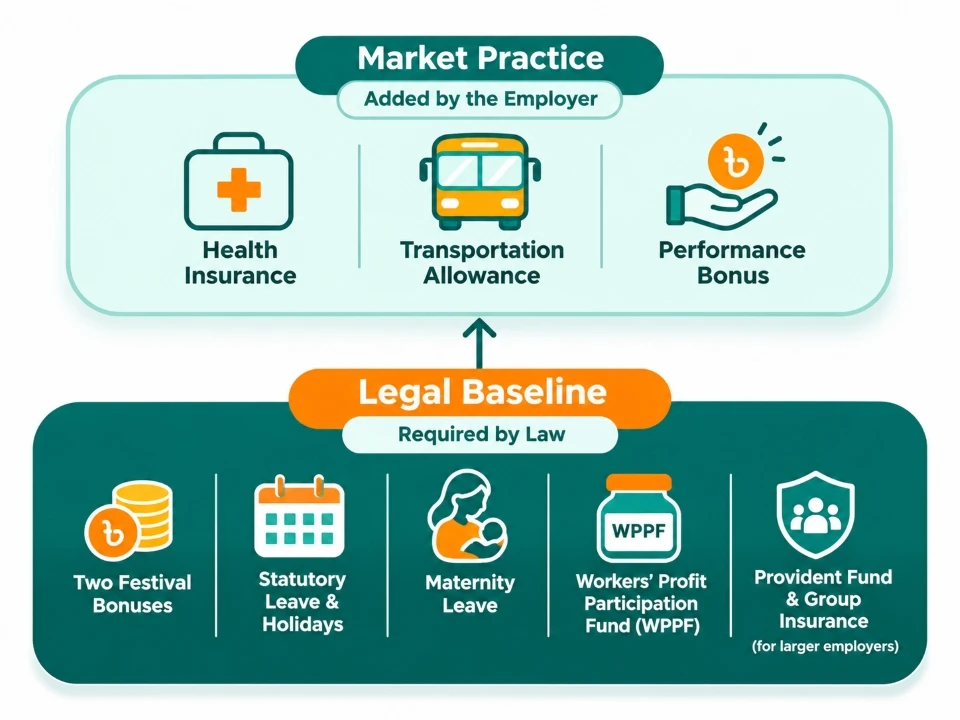
Before you design a package, separate what the law forces you to give from what you choose to give. The first is a compliance cost. The second is a hiring and retention tool.
Benefit | Status | Who it applies to |
Two festival bonuses | Legal requirement | Workers with one year of continuous service |
Statutory leave and festival holidays | Legal requirement | Workers covered by the Labour Act |
Maternity leave | Legal requirement | Eligible female workers |
Workers’ Profit Participation Fund (WPPF) | Legal requirement | Companies above the capital or asset threshold |
Provident fund | Legal requirement for larger employers | Establishments with 100+ permanent workers |
Group insurance | Legal requirement for larger employers | Larger establishments, by headcount threshold |
Health insurance, allowances, performance bonus | Market practice | Employer’s choice |
Bangladesh has no universal social insurance contribution that every private employer must pay for all staff, so the legal layer is narrower than many founders expect.
Employer obligations instead come from the Labour Act, Labour Rules 2015 and subsequent amendments, which define the country's employee benefits framework.
The market layer is where companies compete. Employees expect festival bonuses and health coverage, especially in competitive sectors, and a strong package of optional benefits helps attract talent and reduce turnover.
Festival Bonus Rules Every Employer Should Know
The festival bonus is the benefit your staff watches most closely, and the one most likely to cause a dispute if you miscalculate or pay late. Get the rule right first, then the timing.
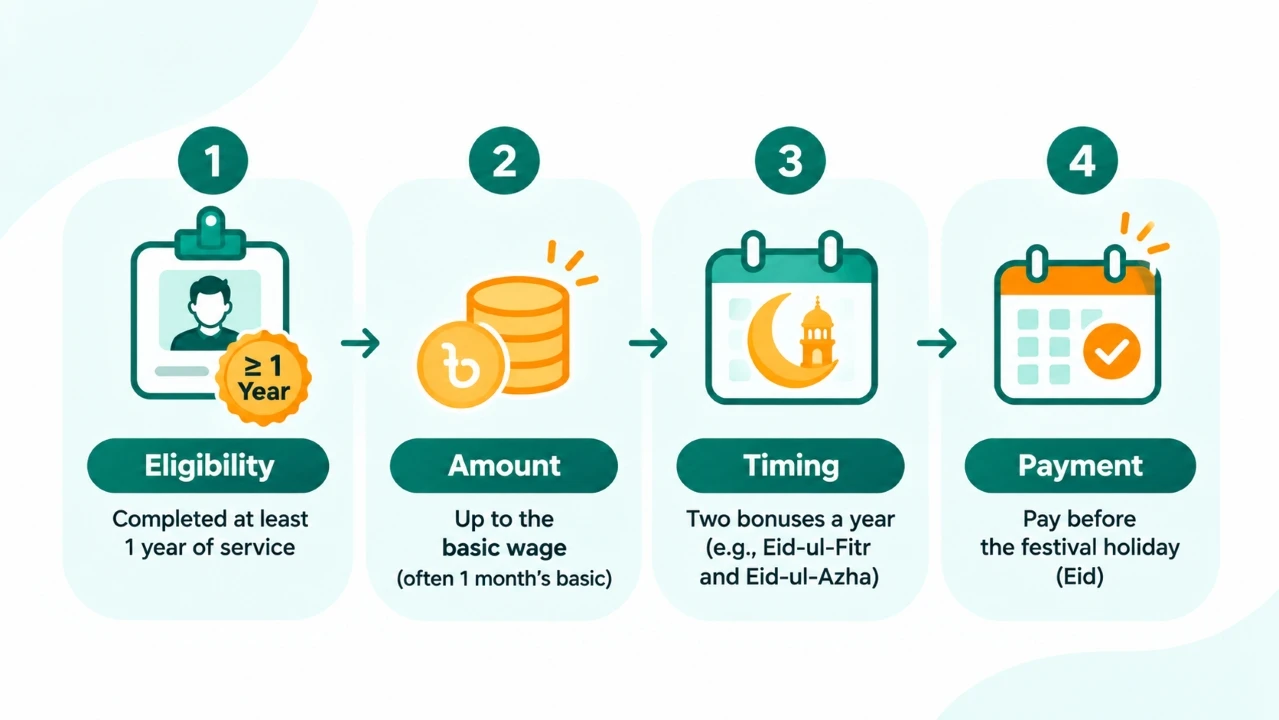
The rule sits in the Labour Rules, not in the main Act. Rule 111(5) of the Labour Rules 2015 requires two festival bonuses a year for employees who have completed at least a year of service in the establishment. Each bonus is capped at the basic wage under the festival bonus rules in Bangladesh.
Here is how the Eid bonus rules in Bangladesh work in practice:
Amount. Each bonus is capped at the basic wage, and the Rules set no explicit minimum. Many employers pay one month’s basic, which is the figure workers and unions treat as the expectation.
Eligibility. The rule applies to “workers” as the Act defines them. Employees who fall outside that definition are not covered by the Rules. Most companies still extend the bonus to all staff through policy or contract.
Timing. Bonuses follow the employee’s own festival. For Muslim employees, that means Eid-ul-Fitr and Eid-ul-Azha, and other communities receive theirs around their own major festivals.
Pre-holiday payment. In March 2026, the labour minister ordered factory owners to clear outstanding wages and festival bonuses before the Eid-ul-Fitr holidays began. This highlighted the importance of completing festival bonus payments before Eid.
Your annual bonus cost is easy to estimate. At the ceiling, it equals basic wage × 2 for each eligible employee. That makes the basic-to-gross split in your salary structure the biggest cost lever: a higher basic share raises both bonus and overtime liability.
Other Statutory Benefits Beyond the Eid Bonus
The festival bonus gets the attention, but the 2025 and 2026 labour reforms changed several other entitlements. These are the areas where outdated HR policies create real exposure.
Leave and holidays. Reporting on the amendment says paid festival holidays rose from 11 to 13 days a year, and maternity leave rose from 112 to 120 days. If your leave policy still shows the older numbers, update it.
Provident fund. Establishments with 100 or more permanent workers now fall under provident fund rules. Employee contributions are 7–8% of basic wage, with a matching employer share. Check the gazetted rule on how the fund is triggered for your establishment, because guides describe the mechanism differently.
Workers’ Profit Participation Fund (WPPF). Companies with paid-up capital of at least Tk 1 crore, or fixed assets of at least Tk 2 crore, contribute 5% of the previous year’s net profit within nine months of year-end, split 80:10:10 across three funds.
Group insurance. Larger establishments must provide it, and sources cite different headcount thresholds. Confirm your own obligation with a labour-law adviser rather than assuming it does not apply.
Because the law changed in stages, a review by a qualified labour-law professional is worth the cost before you finalise any policy.
Employee Benefits Companies Add Beyond the Law

Once the baseline is covered, the benefits you add decide whether your offer beats a competitor’s. Bigger firms usually lead here, but smaller employers can compete on a few well-chosen items.
The most common additions in Bangladesh are:
Group health insurance. Employers commonly cover this fully or partly, sometimes extending it to dependents. One benefits guide puts typical private medical policy limits at BDT 100,000 to BDT 500,000 per employee a year, so get an insurer quote for your own headcount.
Life insurance and supplementary retirement plans. These benefits are more common among larger employers and multinational companies in Bangladesh, where structured compensation packages often include additional financial protection and retirement benefits.
Transport, meal and mobile allowances. They are cheap to run and valued by commuting staff in Dhaka and Chattogram.
Performance bonuses and training budgets. Technology and multinational employers lean on these to attract skilled hires.
Paternity leave. Bangladesh labour law has no provision for paternity leave, which makes it a practical way to stand out.
Tax treatment matters when you structure these. One source notes that most remuneration and benefits are fully taxable, with medical allowance as the exception, so check current NBR rules before you finalise allowances.
How to Plan Increment Salary Reviews Around the Bonus Cycle
Employees treat the annual increment as a benefit, and it interacts with everything above. A raise on basic wage lifts your festival bonus bill, overtime rate, and provident fund contribution in one move.
Plan the review in three steps:
Decide what the increment moves. Raising basic, allowances, or both has different downstream costs. Model each before announcing.
Separate the increment from promotion. Treat a merit raise and a role change as two decisions, so staff understand why each happened.
Set the review date in advance. A fixed month, announced early, prevents the quiet rumour cycle that follows a missed raise.
No fixed percentage applies across the market. Set yours from your pay budget, performance ratings, and what competitors in your sector pay for the same roles.
Aligning salary adjustments with workforce planning also helps ensure that compensation decisions remain consistent with your hiring needs and headcount budget.
Building a Benefits Package Without Overspending

A strong package does not mean the most expensive one. It means spending where your specific workforce feels it.
Work through this sequence:
Lock in the compliance baseline. Cost both festival bonuses, WPPF if you qualify, and any provident fund obligation first.
Identify your workforce type. Office staff, field teams, and factory workers value different things. Health cover suits families, while transport help suits commuters.
Add two or three differentiators. Pick benefits competitors in your sector don’t offer, rather than matching every item on a long list.
Communicate the total value. Show staff the full cost of their package, not just the salary line.
Review once a year. Check usage, cost, and legal changes together.
For smaller businesses, managing recruitment, payroll, and employee administration internally can increase operational costs.
Comparing HR outsourcing with an in-house HR team can help determine which responsibilities are more practical to manage internally and which are better handled externally.
Tracking Bonuses and Benefits in HR Software
Spreadsheets work until the Eid payout, when eligibility dates, basic wage changes, and proration all collide. HR software removes the manual lookups.
Shomvob’s HRIS and payroll platform runs salary payroll with statutory tax and deductions, payslips, and a bank disbursement file. It also tracks attendance and leave balances, so entitlements update as policies change.
Earned wage access is a benefit in itself. It lets employees draw part of the salary they have already earned before payday, with automatic payroll deduction, and it’s useful for field and shift teams.
When payroll calculations, statutory deductions, and festival bonus payments become difficult to manage internally, payroll outsourcing can help businesses handle these recurring responsibilities more efficiently.
Managing employee benefits is only one part of workforce management. When businesses need to expand their teams without adding the full recruitment workload to their HR department, recruitment outsourcing can support the hiring process through external sourcing and screening.
Choosing an Employee Benefits Package That Fits Your Headcount and Budget
The right package depends on three things: your legal obligations at your current size, the benefits your sector’s competitors already offer, and what your workforce values most. Settle those in that order.
For Bangladeshi HR managers, founders and business owners, the decision comes down to compliance, cost and competitiveness. Keep these points in mind:
Pay two festival bonuses on time to every eligible employee, and treat a ministry’s pre-Eid directive as the practical deadline.
Check your size against the thresholds for provident fund, WPPF and group insurance, and confirm each against the gazetted text.
Choose two or three extras that match your workforce instead of copying a multinational’s whole list.
Plan increments alongside the bonus cycle, because basic wage drives several costs at once.
Review the whole package each year, because the labour reforms are still settling.
Building a benefits package that balances employee expectations, compliance and payroll costs requires the right HR processes. If your business needs support with these responsibilities, you can contact the Shomvob team to discuss your requirements.
Employee Benefits and Festival Bonus FAQs
Is the festival bonus mandatory for all employees in Bangladesh? It is a legal requirement for workers with at least one year of continuous service, at two bonuses a year, under Rule 111(5) of the Labour Rules 2015. Employees outside the “worker” definition aren’t covered by the Rules, though most companies pay them anyway.
Can a company pay less than one month’s basic as the Eid bonus? The Rules cap each bonus at the basic wage and set no explicit minimum. Many employers still pay one month’s basic because staff and unions expect it, and your contract or policy may require it.
When must the Eid bonus be paid? There’s no fixed statutory date in the Rules. Ministry directives have asked employers to pay before the Eid holidays begin, and that’s the practical standard.
Do new joiners with less than a year of service get a bonus? The Rules apply after one year of continuous service. Many companies pay a prorated bonus by policy, so write your approach into your HR manual.
Is health insurance mandatory in Bangladesh? There’s no universal rule that every private employer must provide it. Group insurance is required for larger establishments under the amended law, so check the threshold that applies to you.
How much increment should a company give each year? No fixed percentage applies. Set it from your pay budget, performance ratings, and market data for your sector.